
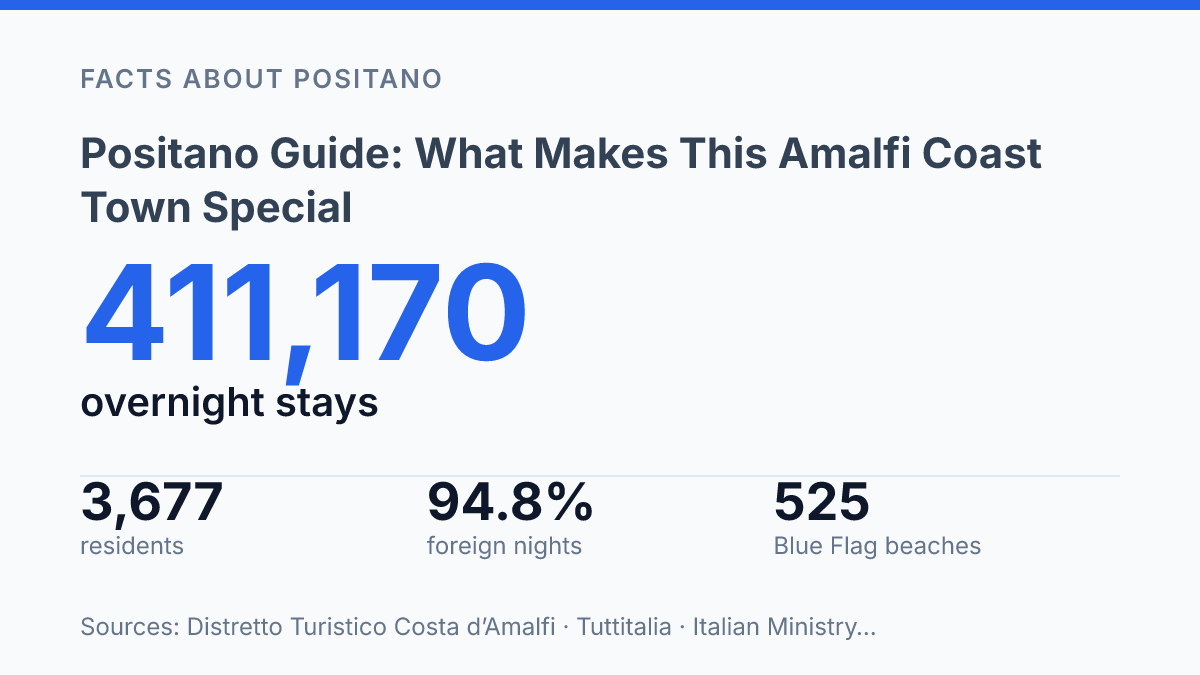
Positano recorded 411,170 overnight stays in 2024 for just 3,677 residents, a ratio that explains why this small Amalfi Coast municipality can feel far larger than its map footprint. The town’s appeal rests on more than resort imagery: it forms part of the UNESCO-listed Costiera Amalfitana, an 11,231-hectare protected area across 15 municipalities, yet its own territory rises from sea level to 1,444 metres. That vertical setting shapes almost everything visitors notice, from stair-linked streets and stacked houses to how beaches, ferries, and hotels function in peak season.
The numbers also complicate the usual picture of nonstop growth, because overnight stays fell by about 10.4% from 2023 to 2024 while remaining overwhelmingly international. Understanding the town means reading geography, tourism pressure, and transport together rather than treating it as a postcard stop.
Where Positano sits on the Amalfi Coast
Positano is compressed between the Tyrrhenian Sea and slopes that the municipal civil-protection plan records as rising from sea level to 1,444 m. That elevation range is not a scenic footnote; it explains why the settlement reads as a coastal town and a mountain town at the same time, with the sea immediately below and steep terrain pressing in from behind.
The town sits on southern Italy’s Amalfi Coast in Campania, within the province of Salerno and along the southern side of the Sorrentine Peninsula. In regional terms, it lies east of Sorrento and west of Amalfi, two reference points that help place it on the coast’s main travel corridor. This position gives the town its strong orientation toward the water while keeping it closely tied to the inland relief that defines much of the Amalfi Coast.
The wider setting is also formally recognised as part of a protected cultural area: the UNESCO World Heritage Centre states that the Costiera Amalfitana property covers 11,231 hectares across 15 municipalities, includes 3 natural reserves, and counts the town among its secondary coastal areas. That framing matters because the location is not simply a resort address; it is part of a larger coastal system where settlement, terrain, and cultivated slopes have developed together over time.
Measured locally, the same geography creates a practical constraint. In its 2024 civil-protection plan, the municipality classifies only 13% of the territory as mostly flat and 79.4% as mostly mountainous. The cliffside setting supports wide sea views and a mild maritime climate, but it also leaves limited level ground for roads, parking, and easy movement, making location central to the town’s character rather than just its map position.
Why the town’s vertical layout stands out
The town’s postcard view is produced less by a single monument than by hundreds of pastel façades stacked in tiers above the water. Seen from across the bay or from an upper lane, the buildings appear to descend in steps toward the shore, with roofs, balconies, church domes, and terraces layered into a compact composition. This vertical arrangement is central to why Positano is so visually distinctive: the town is read almost all at once, from high residential pockets down to the waterfront, rather than as a flat street grid revealed block by block.
Movement through this built form is shaped by stairways, ramps, and narrow pedestrian passages more than by broad streets. Many routes between accommodations, shops, restaurants, and viewpoints involve repeated changes in level, and the shortest path on a map may still require a demanding climb. The lanes often feel intimate because they are enclosed by walls, doorways, small storefronts, and planted terraces, which turns ordinary movement through town into a sequence of framed views and sudden openings.
Commercial and residential life is concentrated on terraces above sea level, rather than spread across a wide plain. Hotels, shops, and homes occupy ledges and slopes at different elevations, so services that might sit side by side in a flatter resort are often stacked above one another. That density helps create the town’s iconic profile and keeps many viewpoints close together, but it also makes access more complicated.
Luggage, strollers, and limited mobility can turn short distances into practical challenges, especially where pedestrian stairways replace vehicle access. The same compact vertical plan that produces memorable views therefore also shapes the effort required to move through the town.
Beaches, boats, and summer tourism
By water, the town functions less like a secluded beach village than a summer transport node: ferries from its main pier connect with Capri in roughly 30–40 minutes. Positano Jet’s 2026 schedules place the departure point at the pier by Spiaggia Grande, with services also linking the town to Sorrento in about 50 minutes and Amalfi in about 15–20 minutes. In peak months, those boat links matter because they reduce dependence on road travel while turning the waterfront into one of the busiest arrival points in town.
Spiaggia Grande and Fornillo are the best-known beach areas, but they serve slightly different visitor patterns. Spiaggia Grande is the central beach, directly tied to boat departures, beach clubs, restaurants, and the most photographed waterfront views.
Fornillo, by contrast, is usually treated as the quieter alternative, though it remains firmly part of the main visitor circuit rather than an undiscovered cove. Italy’s 2026 Blue Flag list, published by the Italian Ministry of Tourism and the Blue Flag programme, includes both beaches, along with Arienzo and Laurito, giving the town four listed beaches in that national quality scheme.
Tourism is large enough to shape the local economy well beyond the beach itself. In 2024, the town recorded 130,907 arrivals and 411,170 overnight stays, according to the Distretto Turistico Costa d’Amalfi, and foreign guests accounted for most of that overnight market. This level of demand supports hotels, restaurants, beach concessions, boat tours, ferry operators, port services, taxi providers, and retail businesses that depend heavily on seasonal footfall.
The same peak period that provides the fullest ferry schedules and widest range of visitor services also brings the tightest conditions. Accommodation, restaurant reservations, boat excursions, beach loungers, and ferry seats can become more expensive or less available as demand concentrates in summer. The result is a practical tradeoff: the high season offers the broadest access to coastal attractions, but it also intensifies congestion and raises the cost of staying near the water.
Planning a visit: timing, transport, and local basics
Late spring and early autumn often offer the most workable balance between operating services and manageable conditions, especially for short stays built around walking and local transport. April to June and September to October are common shoulder-season choices because temperatures are generally less taxing than in high summer, while many tourism services still run. The tradeoff is that sea crossings and some visitor-facing services can remain more seasonal than road access, so dates matter more than the calendar label alone.
Arrival planning usually comes down to three options: regional bus, ferry, or car along the Amalfi Coast road. Buses connect the coast’s towns but share the same narrow road space as other traffic, so journey times can vary.
Driving gives more control over timing before arrival, but limited vehicle space and scarce parking make it a poor fit for casual movement once in town. Ferries can reduce road stress and often provide a more direct-feeling approach, yet sailings are seasonal and can be changed or suspended when weather and sea conditions are unfavorable.
Local conditions reward conservative scheduling rather than tightly packed plans. The town had 3,677 residents on January 1, 2025, according to Tuttitalia’s ISTAT-based figures, which helps explain why visitor services operate within the scale of a small municipality rather than a large resort city. Walking remains part of nearly every stay, and routes between lodging, restaurants, transport stops, and viewpoints can involve sustained climbs or descents.
Rain, heat, and luggage all make those movements slower, while the limited road network reduces the usefulness of last-minute vehicle transfers. For most short visits, the practical advantage comes from choosing arrival times carefully, confirming transport close to travel day, and allowing enough time between connections.
Why scale changes the visit
The most useful way to read the town is as a small mountain municipality operating with the visibility of a global resort. That mismatch makes ordinary choices unusually consequential: a hotel 200 metres from the beach may still involve steep stairs, a ferry can turn a slow coastal road trip into a 15-minute crossing to Amalfi, and a quieter month may change the experience more than a different itinerary.
Tourism will keep shaping services, prices, and crowd patterns, but the underlying geography is less negotiable. The practical consequence is precise: timing, arrival route, and lodging position matter as much as the beach or viewpoint chosen.
Frequently Asked Questions
Q: Why is Positano so famous?
A: Positano is famous for its vertical layout, colorful cliffside buildings, and views over the Amalfi Coast. Its compact streets and stairways create a distinctive hilltown setting that has made it one of southern Italy’s best-known resort destinations.
Q: What is Positano known for?
A: Positano is known for steep stairways, Mediterranean beaches, and houses that appear stacked down the hillside. These features give the town its recognizable profile and make walking through it very different from a typical coastal town.
Q: Is Positano on the Amalfi Coast?
A: Yes. Positano is on the southern Italy’s Amalfi Coast in Campania. Its location places it within one of the region’s most visited coastal areas, where the terrain drops sharply toward the sea.
Q: Is Positano easy to walk around?
A: Positano is walkable, but the terrain is steep and involves many stairs. That means getting around often requires more effort than in flatter towns, especially when moving between the upper streets and the beach.
Q: What kind of beach experience does Positano offer?
A: Positano offers Mediterranean beaches set below a steep hillside town. The beach setting is part of its appeal, but access can involve walking downhill and climbing back up, which shapes the overall visitor experience.