
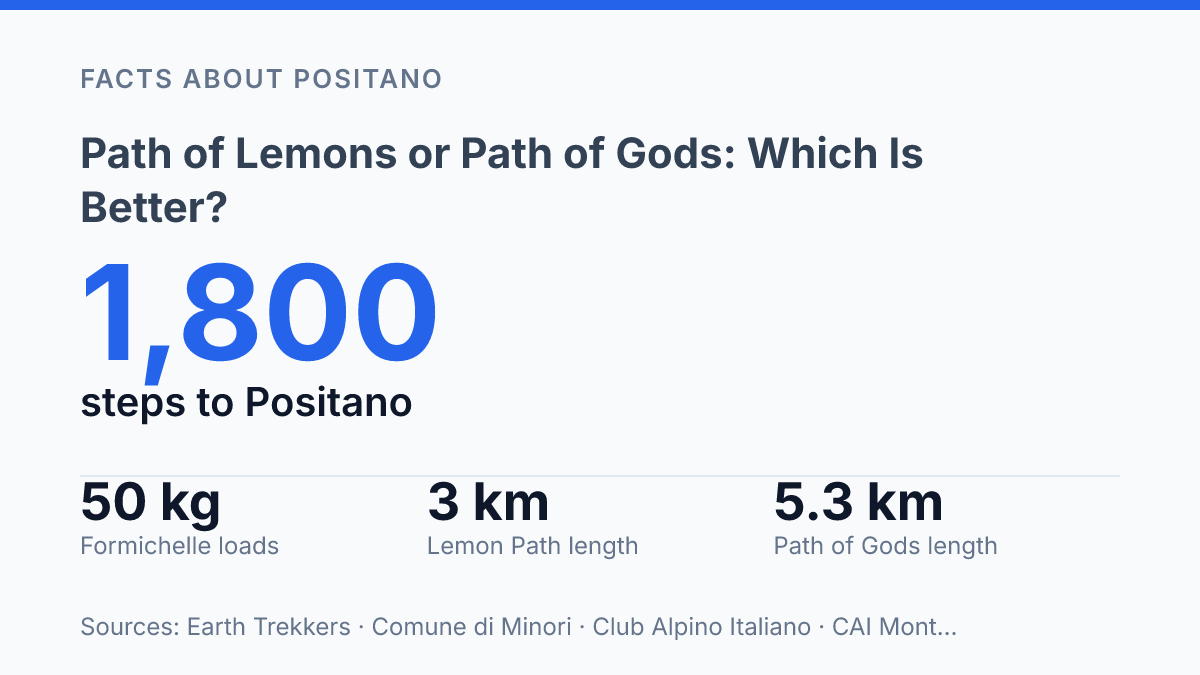
The answer to “Which is better, Path of Lemons or Path of Gods?” changes once the numbers are compared: the Path of the Gods from Bomerano to Nocelle is 5.3 km with 356 m of descent, while the Lemon Path is about 3 km and rated rather easy by CAI Cava. That difference explains why the two routes can produce very different Amalfi Coast days, even though both are often grouped together as scenic walks.
One is a high coastal hike with exposed options near Colle La Serra at 578 m; the other is a shorter route between lemon terraces and towns, with a history tied to the Formichelle who carried baskets of about 50 kg. The comparison depends less on reputation than on effort, timing, access, and the kind of view that makes the day feel worthwhile.
Quick comparison: views, effort, and route feel
CAI Monti Lattari’s 2026 route sheet puts the Bomerano-to-Nocelle Path of the Gods at 5.3 km, with 184 m of ascent and 356 m of descent, making it a hike rather than a scenic stroll. Its route runs high between Bomerano and Nocelle, with altitude listed between 437 m and 630 m, so the experience is shaped by cliffside terrain, exposed sections, and broad views over the sea. The payoff is scale: wide coastal panoramas, a stronger sense of height, and a more adventurous walking rhythm.
By comparison, the Path of the Lemons connects Minori and Maiori on a lower route through terraces and citrus groves. Club Alpino Italiano’s Cava de’ Tirreni section describes it as 3 km, about 2 hours, “rather easy,” and suitable for inexperienced walkers and children. Amalfi Coast Hikes gives a similar practical picture, rating it easy and listing modest elevation change of about +120 m and -130 m, which supports its reputation as the gentler option.
The main distinction is not simply scenery versus scenery, because both routes are attractive in different ways. The higher trail gives the larger, more dramatic coastal outlook, while the lemon walk offers a quieter, orchard-lined route with a closer view of cultivated terraces and village edges. That difference changes the decision: the route with the bigger views is also the one that requires more effort, steadier footing, and greater comfort with height.
For a direct comparison, the cliffside hike suits travelers who want a true walking challenge and sweeping sea perspectives. The citrus route suits those who prefer a shorter, calmer walk with less physical demand. In practical terms, the better choice depends less on which route is more beautiful and more on how much exertion, exposure, and trail feel the walker wants from the day.
When the steeper coastal trail is the better pick
At Colle La Serra, 578 m above sea level, Path of the Gods even offers a choice between a more exposed panoramic branch and a less exposed variant, which captures the character of the route in one decision point. The appeal comes from height, openness, and long coastal sightlines, not from ease underfoot. Uneven limestone, ridge traverses, and stair sections make it a genuine hike rather than a relaxed walk with occasional views.
In 2026, the route from Bomerano to Nocelle is listed by CAI Monti Lattari, 2026 current trail sheet at 5.3 km, 2h00 each way, with 184 m ascent, 356 m descent, and altitude ranging from 437 m to 630 m. Those figures explain why the route feels more demanding than its distance alone suggests: the walk holds the body high above the coast, then repeatedly asks for attention on rough surfaces and changing gradients.
The reward is the strongest scenery in the comparison. From the open ridge, views run across the Amalfi Coast’s folded cliffs and sea-facing villages, with Capri visible on clear days. The same exposure that creates those wide views is also the feature that makes the trail less suitable for anyone seeking a low-effort outing, especially where the path narrows or drops away beside the walking line.
The Nocelle side is relevant for walkers who want the cliffside experience without treating the full Bomerano start as compulsory. With transport to Nocelle, it is possible to walk part of the high route as an out-and-back toward selected viewpoints, then return before the route becomes a longer point-to-point commitment. That option can reduce the total climb and time on uneven trail, but it does not turn the route into a casual family stroll, particularly if the walk is extended down toward Positano, where long stair descents add substantial legwork.
When the citrus walk makes more sense
The route’s most memorable historical detail is physical rather than panoramic: according to the Comune di Minori, the Formichelle once carried lemon baskets of about 50 kg on their heads between the cultivated slopes and the coast. That history gives the citrus walk a practical character, because the steps and lanes pass through a working agricultural setting rather than a purpose-built viewpoint trail. Between Minori and Maiori, the route threads past lemon groves, garden walls, terraces, and small plots that show how farming has shaped the valley as much as tourism has shaped the shoreline.
For families, slower walkers, and mixed-ability groups, the main advantage is the lower physical demand. The pacing is easier to manage than on the higher cliffside route because the walk feels more like a stepped village-and-farmland path than a mountain hike, with fewer reasons to rush and fewer exposed-feeling sections. This makes it a better fit when the goal is a calm half-day walk, especially for people who prefer frequent pauses, a gentler rhythm, or a route that does not require the same level of confidence with height and uneven terrain.
The agricultural setting also explains the route’s connection to limoncello without turning the walk into a tasting itinerary. The local lemons are not just a visual feature; they are part of the area’s traditional citrus economy, from terraced cultivation to the well-known lemon liqueur associated with the Amalfi Coast. That context changes the appeal of the walk: it is less about dramatic altitude and more about seeing the cultivated fabric behind the coastal towns, where narrow stairways, irrigation channels, and stone terraces reveal how citrus farming has long fitted into steep land.
How to choose based on travel style and timing
The same Amalfi Coast walk can be the right choice at 8 a.m. and the wrong one at 1 p.m. in peak summer. Timing should therefore sit alongside fitness when choosing between the two routes, because heat can make climbs, stone paving, and exposed stretches feel more demanding than their basic difficulty labels suggest. Early starts are preferable in warm months, while spring, autumn, and cooler winter days generally give more margin for slower pacing and mid-route pauses.
Path of the Gods is the better match for hikers who want the walk itself to be a major highlight of the trip. It suits travellers who are comfortable with sustained effort, uneven ground, and a route that feels closer to a mountain trail than a coastal promenade. This choice makes most sense when the day has been arranged around the hike, the weather is settled, and the group has enough energy to enjoy the route rather than simply complete it.
The Path of the Lemons is the stronger option for short outings, family groups, and travellers seeking a low-effort half-day walk. It fits more easily into fragmented schedules, especially when a late start, a relaxed lunch plan, or mixed fitness levels would make a more demanding hike feel rushed. Transport timing can also support this choice: Travelmar’s 2026 fare table lists the short Minori–Maiori ferry at €3, which helps frame the citrus route as a simple coastal add-on rather than a full-day hiking commitment.
A practical decision rule is to choose the higher trail when the priority is a memorable hiking experience and the conditions allow a cool, unhurried start. Choose the citrus walk when time is limited, the group includes children or cautious walkers, or the day is already warm enough to reduce enthusiasm for climbs and uneven sections. The better route is often situational rather than absolute: weather, available hours, and group energy can change the answer more than the names of the trails themselves.
What the route choice really measures
The more useful decision is not which trail has the stronger reputation, but which one fits the available margin for error. A late start, summer heat, uncertain knees, or a plan built around ferries points toward the Lemon Path, especially with short coastal links such as Minori–Maiori priced at €3 on Travelmar’s 2026 fare table.
A day reserved for height, exposure, and a longer descent makes the Path of the Gods the clearer candidate. The practical consequence is simple: the better route is the one whose hardest part still sounds appealing after transport, weather, and the walk back to sea level are counted.
Frequently Asked Questions
Q: Is the Path of the Gods harder than the Path of the Lemons?
A: Yes. The Path of the Gods is the more demanding route because it is a true hiking trail with higher elevation and cliffside terrain. The Path of the Lemons is generally easier and better suited to a relaxed walk.
Q: Which trail has better views, the Path of the Gods or the Path of the Lemons?
A: The Path of the Gods is better for dramatic panoramic views, especially along the high cliffs above the coast. The Path of the Lemons offers calmer scenery through citrus groves and local countryside, which is less dramatic but more peaceful.
Q: Which walk is better for families?
A: The Path of the Lemons is usually the better choice for families because it is easier and more relaxed. Its gentler pace and lower effort make it more suitable for children and casual walkers than the steeper Path of the Gods.
Q: What kind of experience does the Path of the Gods offer?
A: The Path of the Gods is designed for travelers who want a more adventurous hike with striking coastal scenery. It combines steep sections, open views, and a stronger sense of effort, which makes it more rewarding for active walkers.
Q: What kind of experience does the Path of the Lemons offer?
A: The Path of the Lemons is a quieter route focused on local agricultural scenery, especially lemon groves. It is better suited to visitors who want a peaceful walk rather than a strenuous trek.