
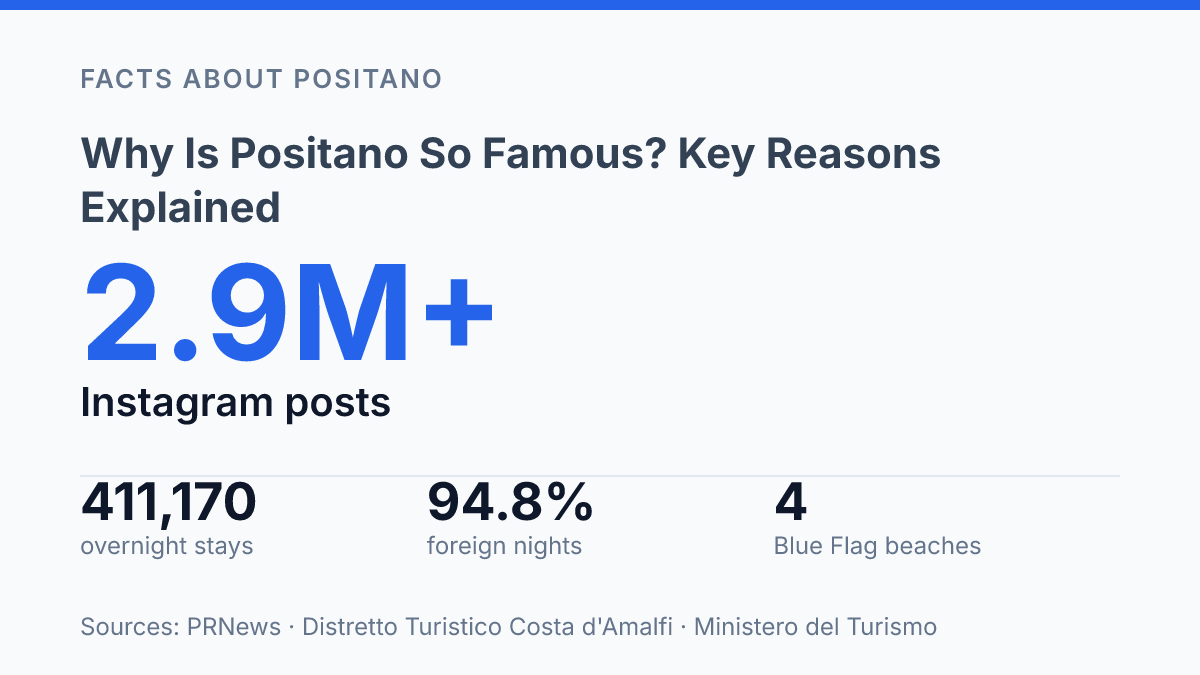
The answer to “Why is Positano so famous?” begins with a measurable imbalance: in 2024, this town of 3,751 residents recorded 411,170 overnight stays. Its reputation is not built on one attraction alone, but on the rare alignment of geography, architecture, coast access, and image-making. UNESCO’s 1997 Amalfi Coast inscription covers 11,231 hectares across 15 municipalities and identifies the area’s value in dramatic topography and settlements shaped by terrain, a description that fits Positano with unusual precision.
The town rises from sea level to steep hillside, with pastel buildings arranged in the “pyramid” form promoted by its own tourism office. Beaches such as Spiaggia Grande and Arienzo add another layer, while film, fashion, and social media keep the view circulating far beyond Italy. Positano’s fame is best understood as a feedback loop between place, access, and global visibility.
The cliffside setting that defines Positano
Within Positano’s municipal boundary, land rises from sea level to 1,400 metres, which helps explain why the town reads less like a conventional coastal resort than a settlement poured down a mountainside. Tuttitalia’s ISTAT-derived municipal data place the town hall at 145 metres above sea level, while the wider territory reaches much higher ground, giving the built area its sharp vertical character. On the Amalfi Coast, this steep descent toward the Mediterranean Sea is not a background feature; it is the physical condition that determines how the town is seen, reached, and built.
The shortage of flat land forces development upward rather than outward. Streets, stairways, terraces, retaining walls, and buildings have to adapt to slopes that leave little room for broad squares or a simple grid plan. This geography gives the town its compressed profile, with homes and hotels appearing to climb the hillside in tiers rather than spreading along a level waterfront.
UNESCO’s inscription of the Amalfi Coast in 1997 identifies the area’s value partly through its topography and the way settlements were shaped by geography. Positano fits that description especially clearly because its fame depends on the relationship between the cliff, the sea, and the built form. The result is a place where the first impression is often spatial before it is architectural: height, drop, and exposure define the view.
That exposure is central to tourism and photography. Panoramic sea views allow the town to be photographed from roads, terraces, boats, and elevated paths, producing a recognizable silhouette even before individual buildings are noticed.
The same terrain that creates those views also adds practical constraints, making walking, access, maintenance, and construction more demanding than in flatter coastal towns. Positano’s setting is therefore both an attraction and a limitation, and that tension is a major reason its image remains so distinctive.
Pastel houses and stacked architecture
Positano’s best-known image is not a single landmark but a compressed wall of cream, peach, pink, and ochre façades rising behind the beach. The municipality’s tourism office describes the view from Spiaggia Grande as a full-circle vantage point and refers to the famous pyramid of coloured houses set one above another behind the shore, a description that closely matches how the town appears in travel photography. From this angle, the buildings seem to form a single terraced surface, with balconies, shutters, cupolas, and rooflines layered so tightly that the settlement reads almost like architecture and backdrop at the same time.
That stacked appearance is not only decorative. In a town with little level ground, houses and small civic buildings are arranged in tiers, with one roof often sitting near the floor level of the property above it.
The result is a dense vertical pattern in which pastel colour softens the mass of construction while repetition gives the town its recognisable rhythm. This is why images of Positano often emphasise the whole slope rather than individual buildings: the fame lies in the collective composition.
Movement through the town reinforces the same visual identity at street level. Narrow lanes, vaulted passages, stairways, and terraces connect buildings across different levels, so the town is experienced as a sequence of climbs, turns, and framed views rather than as a conventional grid. The official description of Spiaggia di Arienzo as the beach of the 300 steps underlines how ordinary access routes become part of the architectural character, not just a way to move between places.
Offshore views intensify the effect because the sea removes the interruptions of street-level perspective. From boats, the clustered façades appear to rise directly from the waterfront, making the colour gradient and tiered construction easy to capture in a single frame. That is why the classic Positano image is so often taken either from the main beach looking inland or from the water looking back: both viewpoints compress the town into the pastel, stacked form that has become its visual signature since at least the way local tourism materials presented it in 2024.
Beaches, boats, and the Amalfi Coast draw
For many arrivals, Positano is experienced first as a landing point rather than a viewpoint: ferries and excursion boats place passengers beside Spiaggia Grande, the town’s main beach and its most recognizable seafront threshold. That practical role matters because the beach is not only a place to swim; it is also where the town connects to the wider coast by water, making the first impression immediate and highly concentrated.
The coastal setting has formal recognition beyond local promotion. The UNESCO World Heritage Centre inscribed the Amalfi Coast in 1997, covering 11,231 hectares across 15 municipalities and identifying Positano as one of the property’s secondary coastal areas, with the coast’s value tied to dramatic topography and settlements shaped by geography. In practical terms, this places Positano inside a larger protected cultural and scenic corridor rather than treating it as an isolated resort town.
Boat routes strengthen that position. Seasonal ferries and private boat services commonly link Positano with Capri, Amalfi, and other coastal towns, allowing visitors to treat it as one stop in a chain of sea-based destinations. This is especially important on a coast where road journeys can be slow and crowded during peak periods, while travel by water turns the approach itself into part of the experience.
Positano’s fame also depends on its place within itineraries beginning in larger gateways such as Naples or Sorrento. Visitors often reach the area by rail, road, or transfer from those hubs, then continue along the Amalfi Coast by bus, car, ferry, or organized excursion. Positano benefits from being both a destination and a midpoint: close enough to fit into a day trip for some travelers, but distinctive enough to justify overnight stays for others.
The beach credentials are real, though limited by scale. Italy’s 2026 Blue Flag listings include Positano beaches such as Fornillo, Spiaggia Grande, and Laurito, giving the town a recognized quality marker for bathing areas.
Yet the shoreline is relatively compact, so the draw is not based on long, expansive beaches alone. Its appeal comes from the combination of sea access, boat mobility, and inclusion in one of Italy’s most sought-after coastal routes.
Why films, fashion, and social media keep it visible
A single hashtag has made Positano’s image measurable at global scale: a 2025 PRNews report ranked the town first among Europe’s most popular Instagram beach destinations and said #positano had appeared in more than 2.9 million Instagram photos and videos. That volume matters because the town’s fame is no longer carried only by guidebooks, postcards, or word of mouth. Repeated sharing turns the same recognizable views, terraces, cafés, hotel balconies, and summer outfits into a circulating visual shorthand for coastal luxury.
Film, travel photography, and lifestyle media have reinforced that recognition by presenting the town less as a conventional resort and more as a ready-made setting. Productions and editorial shoots do not need to explain the location at length because its visual codes are already legible: steep streets, sea-facing terraces, bright façades, and tightly framed views. This makes the town especially useful in lifestyle coverage, where atmosphere, aspiration, and visual immediacy often carry as much weight as practical travel information.
Fashion has strengthened the same effect through what is commonly described as Positano style, a resort-wear look associated with linen dresses, loose shirts, sandals, embroidered fabrics, straw accessories, and boutique displays aimed at warm-weather visitors. The style is not separate from the place; it is part of how the destination is photographed and consumed. Clothing, shopfronts, beach clubs, and hotel terraces form a consistent summer image that travels easily across magazines, influencer posts, and commercial campaigns.
The scale of international demand shows that this visibility translates into real visitor pressure. In 2024, Positano recorded 130,907 arrivals and 411,170 overnight stays, with foreign visitors accounting for about 94.8% of recorded nights, according to Distretto Turistico Costa d’Amalfi and ISTAT data.
Media exposure helps explain why the town is recognizable far beyond Italian travel circles, but it also contributes to a more managed seasonal experience. In peak periods, the same polished visibility that attracts visitors can make parts of the town feel curated for cameras and short stays rather than shaped primarily by everyday residential life.
What fame means in a town built on limits
Positano’s next challenge is not recognition but proportion. A place with roughly 110 tourist nights per resident in 2024 depends on the same small-scale streets, stairways, beaches, and sea approaches that make it distinctive. That tension does not diminish its appeal, but it changes how the town is understood: fame becomes a management question as much as a cultural one.
The strongest reason Positano remains recognizable is also the reason it cannot expand easily. Its image is tied to compression, height, and limited space. Any future version of its popularity will depend on preserving those constraints rather than trying to smooth them away.
Frequently Asked Questions
Q: What makes Positano different from other Amalfi Coast towns?
A: Positano is most closely associated with its steep hillside layout and houses that appear to rise directly from the cliff face. That vertical form creates layered sea views and a dense visual profile that is less typical of flatter coastal settlements.
Q: Why do people travel to Positano for photos?
A: The town offers strong visual contrast between colorful pastel houses, rocky slopes, and the blue Mediterranean Sea. That combination produces wide, elevated viewpoints and tightly framed streets that photograph well in both landscape and street scenes.
Q: Is Positano famous mainly for its scenery or for its history?
A: Its modern fame is driven mostly by scenery, especially the dramatic cliffs and coastal views. Historical interest is present, but the town’s international recognition is more strongly tied to its appearance than to a single historical event or monument.
Q: What is the best-known feature of Positano’s buildings?
A: The town is known for dramatic vertical architecture, with homes stacked into steep terrain rather than spread across a flat center. This arrangement shapes both the skyline and the way streets, stairs, and viewpoints connect through the town.
Q: Why does Positano attract so many visitors each year?
A: Its appeal comes from a combination of scenery, compact walkable areas, and clear sea views from many parts of town. The setting creates a distinctive sense of place that has helped make it one of the most recognizable destinations on the Amalfi Coast.