
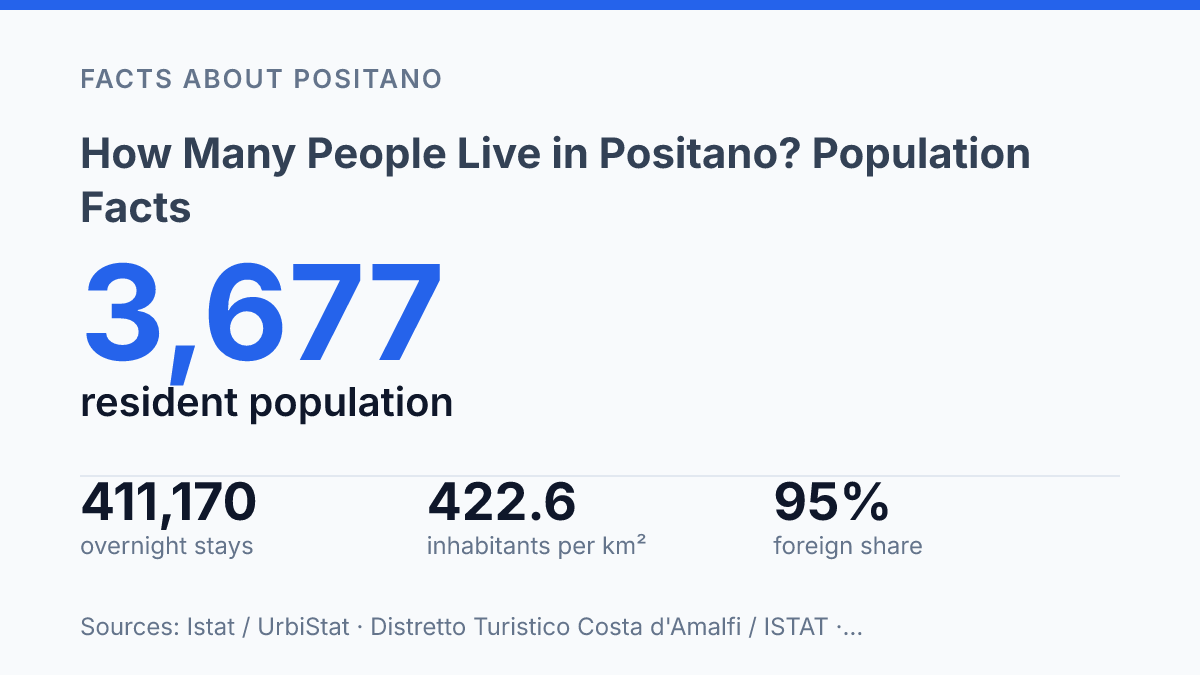
How many people live in Positano has a clear statistical answer: 3,677 residents in 2024, according to ISTAT-linked figures, in a municipality of just 8.70 km². That number sits uneasily beside the town’s public image, because Positano also recorded 130,907 tourist arrivals and 411,170 overnight stays in the same year. The result is a place that is demographically small but seasonally intense, with daily life shaped by far more than the resident register.
Its population is also slightly declining, relatively old, and concentrated in households averaging about 2.39 people. Those details help explain why the town can feel crowded without being large, and why comparisons with Amalfi, Maiori, Ravello, and Praiano require more than a simple headcount. The population figure is the starting point, but the pressure on the town is better understood through density, age structure, geography, and tourism volume.
Positano’s current population and latest census figure
Positano’s official resident count is just 3,677 residents in 2024, a figure that refers to the municipality rather than the summer crowd or only the postcard-like historic core, according to Istat / UrbiStat. This is the clearest current baseline for the town’s permanent population and should be read as an official resident-population snapshot, not as a measure of how many people are physically present on a busy day.
The count applies to the Comune di Positano, the local administrative municipality, which includes the town and its resident population as recorded through official demographic registers. It is not limited to the historic centre, nor does it count tourists, short-stay visitors, hotel guests, second-home occupants who are registered elsewhere, or seasonal workers unless they are formally resident in the municipality.
Small Italian municipal populations can shift modestly from one reporting date to another because births, deaths, address changes, and registry updates alter the official total over time. For that reason, the 2024 figure is best treated as the latest official reference point rather than a permanent constant. It answers the resident-population question precisely, while leaving separate questions about seasonal presence, visitor numbers, and crowding to other data sources.
Why the town feels larger in summer
Peak-month footfall can make Positano look less like a village-scale municipality and more like a compact resort district absorbing thousands of temporary users each day. In 2024, Positano recorded 130,907 tourist arrivals and 411,170 overnight stays, according to Distretto Turistico Costa d’Amalfi / ISTAT data published in 2025. That works out to a volume of paid visitor nights far beyond the town’s resident base, which helps explain why streets, stairways, bus stops, and ferry approaches can feel crowded even though the official population remains small.
Seasonal accommodation is the mechanism that turns visitor demand into a much larger daily presence. Hotels, guesthouses, villas, serviced rooms, and short-let apartments all expand the number of people sleeping in the municipality without adding to the register of permanent residents.
Many of these stays are concentrated in the warmer months, so the effect is not spread evenly across the year. A town that may feel quiet in winter can carry a very different load when rooms are full, day-trippers arrive, and transport movements overlap.
Sensor data gives a clearer sense of the gap between resident population and daily pressure. During peak periods, the tourism district reported about 260,000 person passages per month in Positano, a level many times larger than the number of people who actually live there year-round.
These passages are not the same as unique visitors, and they should not be treated as a population count. They measure movement through monitored areas, which is more useful for understanding crowding than for answering a residency question.
This distinction matters because visitor volume and population measure different things. Permanent residents are counted through municipal registration, while tourists may stay for one night, rent a villa for a week, visit for the day, or pass through the centre more than once.
Positano can therefore feel densely occupied for several months while still having the demographic profile of a small coastal community. Using summer crowd levels as a substitute for resident count would overstate the number of people who live there and understate the seasonal strain created by tourism.
What shapes a small coastal population
Positano’s municipal footprint is only 8.70 km², and much of that space is steep slope rather than buildable ground. UrbiStat’s 2024 municipal profile gives the town a density of 422.6 inhabitants per km², a figure that reflects not only a compact population but also a sharply constrained physical setting on the Amalfi Coast. In practical terms, the cliffside form limits where permanent housing, service buildings, parking, and public space can be added without major engineering or visual impact.
The same topography that gives Positano its recognisable vertical profile also narrows the supply of land suitable for year-round residence. Homes, hotels, shops, and civic functions compete for limited terraces and accessible plots, while roads must follow difficult contours rather than a simple grid. Flat land is scarce, and expansion is harder than in inland towns where new residential districts can spread across broader valleys or plains.
Housing pressure is shaped by more than geography, because the local economy is strongly oriented toward tourism-facing work. Hospitality, restaurants, transport, retail, maintenance, cleaning, and personal services all form part of the town’s employment base, and many of these activities intensify during the visitor season. That pattern can support substantial economic activity in a small place, but it does not by itself create a large permanent population when housing remains limited and many jobs are tied to seasonal demand.
Demographic structure adds another constraint. ISTAT-based data published by Tuttitalia show that, at 1 January 2025, Positano had far more residents aged 65 and over than children aged 0–14, with an old-age index of 221.5 seniors per 100 young people. This indicates an older resident profile than the resort image might suggest, and it helps explain why the town’s settled community can remain modest even while its economy and public spaces are highly active for much of the year.
How Positano compares with nearby Amalfi Coast towns
Sorrento has more than four times Positano’s resident base, while Praiano has a little over half of it. On 31 December 2024, Tuttitalia’s ISTAT-based municipal resident counts put Amalfi at 4,610 residents and Praiano at 1,940, placing Positano between the two nearby Amalfi Coast communes rather than at either extreme.
The same source-year comparison changes the scale of the question when Sorrento is included as a larger nearby coastal hub. Tuttitalia’s ISTAT-based figures for the end of 2024 place Sorrento at roughly 15,600 residents, making it far larger than Positano in resident-population terms. This single comparison shows that Positano is not just smaller than a regional service centre; it is in a different municipal size category altogether.
Direct comparisons are most useful when they keep the administrative unit constant. These figures refer to resident populations inside municipal boundaries, and those boundaries are not drawn in identical ways along the coast. Some communes include wider inland areas, different fractions of hillside settlement, or a larger service role beyond the postcard centre associated with the town name.
That caveat does not make the comparison invalid, but it limits what it proves. Positano is smaller than Amalfi by the official resident count and larger than Praiano, so it is not unusually tiny for the immediate coastal strip. Against Sorrento, however, the gap is large enough to show why Positano functions demographically as a small commune even though its international profile is much bigger.
Why the resident count only tells part of Positano’s scale
Positano’s resident count is most useful when treated as a baseline rather than a full measure of the town’s scale. A municipality of 3,677 people that receives more than 411,000 overnight stays in a year has to manage two different realities: the permanent needs of a small, older community and the temporary demand created by an international visitor economy. That distinction affects transport, housing, public services, waste collection, and the character of local commerce.
Future population changes may be modest, but visitor pressure can shift quickly with travel trends, accommodation supply, and transport policy. The practical consequence is clear: Positano’s size is fixed by geography, while its effective population expands and contracts with the season.
Frequently Asked Questions
Q: What is the current population of Positano?
A: Positano is a small town with a resident population in the low thousands. Exact counts can shift slightly from year to year because population registers are updated as people move in and out.
Q: Why does Positano seem much busier than its population suggests?
A: Visitor numbers are far higher than the number of permanent residents, especially during the tourist season. That difference makes streets, beaches, and transport links feel crowded even though the local population is relatively small.
Q: Does Positano have more residents in summer?
A: The number of permanent residents does not usually change dramatically in summer, but the number of people present in town rises sharply. Seasonal workers, tourists, and short-term guests increase foot traffic and local demand.
Q: How does Positano compare in size to other Amalfi Coast towns?
A: Positano is one of the better-known towns on the Amalfi Coast, but its resident base is still modest. Many nearby towns are similarly small in population, which is common in this coastal region where geography limits large-scale expansion.
Q: Where can population figures for Positano be checked?
A: Official Italian statistical sources and local municipal records are the most reliable references. They provide the most accurate basis for understanding resident population, though tourism-related crowd levels require separate visitor data.