
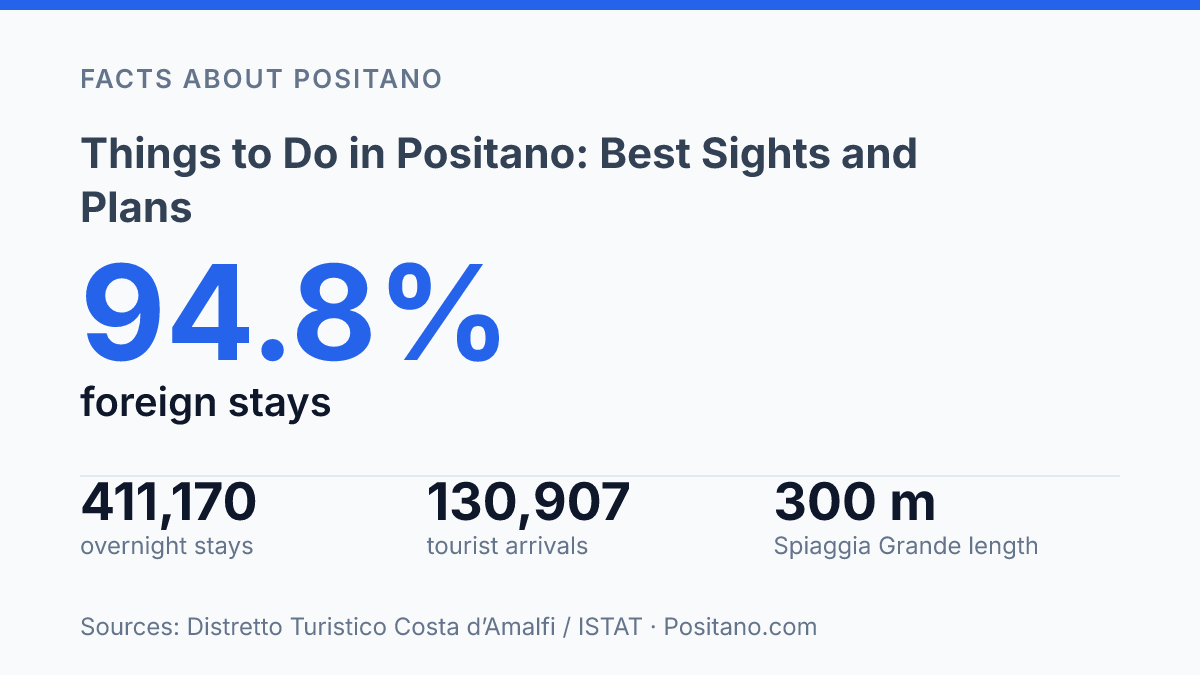
Things to do in Positano become a timing problem fast: in 2024, this cliff town logged 411,170 overnight stays, and nearly 95% came from abroad.
That changes the way you should plan. The prettiest view may not be the smartest first stop. The famous beach may be perfect at 9 a.m. and punishing by noon.
Start with Spiaggia Grande, not because it’s hidden, but because it explains the town in one place. It’s 300 meters of beach, boat departures, paid rows, free space, and people trying to make the same short visit work.
In my honest opinion, the best Positano plan is not the fullest one. It’s the one that respects heat, stairs, ferry times.
The fact that July sun doesn’t care how good your itinerary looks on paper. This guide helps you choose what to see, when to slow down, what to pack, and how to make one or two days feel intentional.
Top places to see first
In 2024, Positano recorded 130,907 tourist arrivals and 411,170 overnight stays, with foreign visitors making up about 94.8% of all overnights, according to Distretto Turistico Costa d’Amalfi / ISTAT. That tells you exactly how to approach the village: choose the high-value stops first, then let the rest happen slowly.
Built into the cliffs of the Amalfi Coast in the province of Salerno, Italy, the town rewards walkers who don’t mind stairs. The layout looks romantic from the ferry, but on foot it can turn a five-minute map distance into a sweaty climb. That contrast matters when you’re trying to see the best parts without wasting your day.
Start at Spiaggia Grande. It’s the broad beach at the base of the village and the easiest place to understand the whole setting at once: sea in front, pastel houses stacked above, boats moving in and out below the cliffs.
The catch is obvious by mid-morning. The most photographed view is also where everyone else wants to stand.
From the sand, walk toward the Church of Santa Maria Assunta. Its tiled dome is one of the cleanest visual anchors in town. It sits close enough to the beach that you won’t burn time getting there. In my view, this small area gives you the best return for a short visit, especially if you only have a few hours.
Fornillo Beach is the better second stop if you want breathing room. The walk from the main beach is short.
It filters out some of the crowd. It doesn’t feel hidden, exactly… just less consumed by the postcard rush.
Heat changes the plan fast in July, when average highs sit around 30°C to 32°C. Go uphill early if you want those layered cliff views, then drop back down before the stone lanes start holding the heat. The best view isn’t always the easiest one to reach, but that’s the tradeoff that makes the visit work: you save energy for the places that actually earn the climb.
Beach time, boat rides, and summer pacing
The easiest beach day in Positano can become the hardest plan by 11 a.m. Boat time sounds relaxing, but midday heat and packed shorelines can make a simple swim feel like a logistics test. Go early.
Leave loose. That one rule saves more stress than any perfect itinerary.
Spiaggia Grande is the practical choice when you want everything close: loungers, beach clubs, boat departures. The main postcard view. Positano.com lists it as a 300-meter-long beach, with paid bathing areas plus a free section.
It handles more people than the smaller coves. The tradeoff is obvious. More space doesn’t mean more calm.
Fornillo Beach works better when you want a slower swim and fewer people around your towel. It’s smaller than the main beach and feels more tucked away. The mood changes fast once you leave the central shore. In my honest opinion, Fornillo is the better beach for actually relaxing, not just proving you made it to Positano.
Boats give the day a different rhythm. Ferries can take you toward Amalfi or Capri, and private boats can shape the trip around swims, photos, or a quieter run toward Li Galli. Current Capri.com ferry listings for 2026 show Positano-to-Capri crossings at about 40 to 50 minutes, with fares from roughly €27.50 to €29, so Capri is possible without giving up the whole day.
Private boats cost more. They solve a real problem: fixed schedules don’t care how hot, tired, or crowded the port feels.
A short coastal ride can be smarter than a packed full-day plan, especially if you’re traveling with kids or you don’t want to race back for a timed ferry. The water looks effortless from shore… the planning isn’t.
By July, clothing becomes part of the plan, not an afterthought. Light, breathable fabrics help when temperatures reach 30°C to 32°C, especially if you’re moving between beach stones, ferry queues, and sun-heavy walkways. If you want beach time and a boat ride in one day, swim early, ride before or after the worst heat, then slow down instead of adding one more stop.
What to pack for a hot July day
In July, the smartest item in your bag may be the least photogenic: shoes with grip. Positano rewards people who can move comfortably, not people who packed for a resort brochure. The streets rise fast. The stairs make every extra layer feel like a mistake.
Pack light, breathable clothing that dries quickly and doesn’t cling. Linen, cotton, and loose technical fabrics work better than thick denim or tight dresses. The clothes that look best in photos are rarely the clothes that feel best on Positano’s stairs… and that tradeoff matters by noon.
Footwear deserves more thought than style. Bring comfortable walking shoes or supportive sandals with real soles.
Flat leather slides may look right at lunch. They can punish you on steep routes and polished stone steps. In my humble opinion, good shoes are the difference between enjoying the town and silently resenting every climb.
Sunscreen isn’t optional when average highs sit between 30°C and 32°C. Use a high-SPF sunscreen and reapply it, especially if you’re walking between viewpoints, shops, and waterfront stops. Weather Atlas lists Positano’s maximum UV index at 7 in July, so shade alone won’t do enough.
A refillable water bottle earns its space. You’ll drink more than you expect, and buying small bottles all day gets annoying fast.
Keep the rest of your day bag lean: sunglasses, a hat, a light cover-up. A small cloth or scarf for hot railings, seats, or sudden sun exposure.
Skip heavy bags unless you enjoy carrying your regrets uphill. A compact crossbody or small backpack works best. You want both hands free on stairs, especially when the crowds tighten and the pavement gets slick from sea spray, sandals, and summer traffic.
Short trip plan for one day or two
The best short itinerary here has fewer stops than you think. Positano sits in Salerno province on the Amalfi Coast. It tempts travelers to tack on another town, another swim, another photo stop.
Don’t. Trying to see everything is the fastest way to enjoy nothing here.
For one day, start with the beach before the town fully wakes up. Keep it simple: swim, rent a chair if that’s your style, or just sit long enough to feel like you’ve arrived.
Then walk through the center in small pieces rather than treating it like a checklist. Stop for the church area, the lanes above the water, and one proper pause for lunch or a cold drink.
After that, choose one finale. Take a short coastal boat loop if the sea looks calm, or climb to a viewpoint if you’d rather stay on land.
The boat gives you the postcard angle. The viewpoint gives you the town’s real shape: stacked, steep, and less tidy than it looks from below. In my view, the viewpoint is the better choice if you only have one golden-hour slot.
A two-day plan should not mean twice as much running around. Use the first day for the beach, the center, and one water or view stop. On day two, give yourself a slower beach morning or add a longer coastal boat outing.
That extra space changes the trip. You stop checking the time every ten minutes.
If you want something more active, make it the main event. The Sentiero degli Dei is about 7.8 km and takes around three hours, linking Agerola with Nocelle above town, according to Positano.com.
That’s not a casual add-on after a beach day. Do it early, then keep the rest of the day light.
Transport can shape the plan more than distance does. The Amalfi Coast District’s 2026 traffic notice says alternate-plate rules apply on the SS163 from 10 a.m. to 6 p.m. on weekends from June 6 to July 31, then daily in August and September.
If you’re driving or hiring a transfer, build the day around timing. A relaxed plan beats a clever one that falls apart on the road.
What the smart plan buys you in Positano
Positano rewards people who make a few hard choices before they arrive.
If you’re visiting after June 6, treat the SS163 rules as part of the itinerary, not fine print. A place can be only a few miles away and still cost you half a day if you ignore the road, the ferry window, or the heat.
That’s the tradeoff here. Positano looks effortless from the water. It asks for discipline on land.
In my humble opinion, leave one tempting plan out. Pay for shade when it matters. Take the early boat.
Save the long walk for a morning when your legs still like you. The best version of this trip isn’t the one with the most stops. It’s the one you still enjoy at 4 p.m..
Frequently Asked Questions
Q: What is the best thing to do in Positano first?
A: Start with the old town and the stairways. That gives you the steep streets, the sea views. The real rhythm of the village fast. In my view, it’s the smartest first stop because everything else makes more sense after that.
Q: Is Positano good for a day trip or do you need to stay overnight?
A: You can do a day trip. It feels rushed. An overnight stay gives you quieter mornings and time to enjoy the coast without hurrying back. The tradeoff is simple: day trips save money. A night there gives you a better experience.
Q: What should I wear in Positano in July?
A: Pack light, breathable clothing. July is hot and sunny, with average highs of 30°C to 32°C, so heavy fabrics get uncomfortable fast. A hat and good walking shoes help too, since the village is steep.
Q: How do you get around Positano without a car?
A: On foot is the main way. The village is built on a cliff, so stairs and narrow lanes are part of the experience. Buses and boats help for longer hops. They won’t replace walking inside town.
Q: What part of Positano gives the best views?
A: The upper sections of town give the widest views over the sea and rooftops. You get a better angle there than near the beach, but you’ll earn it with plenty of stairs. Positano sits on the Amalfi Coast in the province of Salerno. That steep setting is exactly why the views are so strong.